Miss Baker.
She flew 360 miles into space. She weighed one pound. She was approximately one year old. She came back fine.
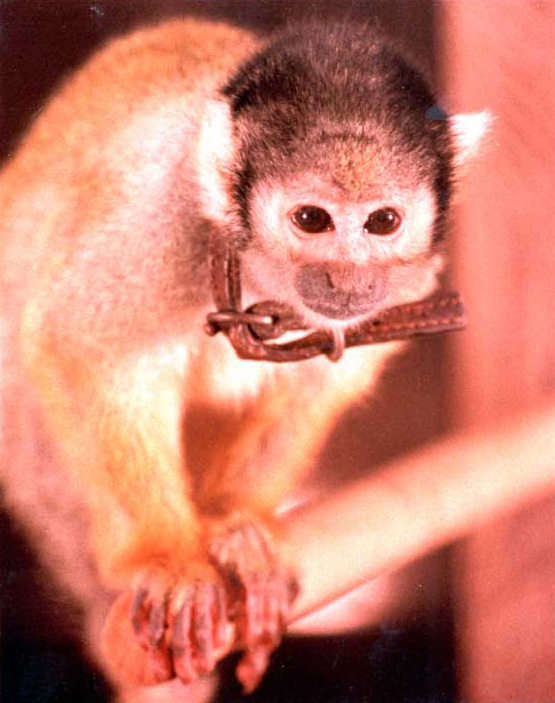
The mission
On May 28, 1959, a South American squirrel monkey named Miss Baker was sealed inside a custom biocapsule fitted into the nose cone of an Army Jupiter AM-18 ballistic missile at Cape Canaveral Air Force Station, Florida. She was approximately one year old and weighed roughly one pound. She had no concept of what was about to happen.
The rocket launched from Launch Complex 26 at 2:35 a.m. and carried Miss Baker and a rhesus monkey named Able on a suborbital trajectory. It reached an altitude of 360 miles and a speed of approximately 10,000 miles per hour. Miss Baker experienced 38 Gs of force during re-entry. Sixteen minutes after launch, the nose cone was recovered from the Atlantic Ocean. Miss Baker was alive and in good health. She ate a large meal shortly after retrieval.
They were the first U.S.-launched animals to survive spaceflight and be recovered alive. The mission collected continuous biomedical data — heart rate, respiration, body temperature, muscle activity — throughout the flight. The data showed no significant adverse physiological effects from acceleration, weightlessness, or re-entry. It fed directly into the planning for human spaceflight. Able died four days later during a procedure to remove a medical electrode. Miss Baker did not.
After the mission
Miss Baker retired from research and was transferred to the U.S. Space & Rocket Center in Huntsville, Alabama. She lived there for the rest of her life — more than twenty-five years. She became one of the most visited and photographed residents of the facility. She had a mate named Norman.
She died on November 29, 1984. She was approximately 27 years old. The average lifespan of a squirrel monkey in captivity is 15–20 years. She outlived that by a significant margin.
Where she rests
Miss Baker is buried in front of the Davidson Center for Space Exploration at the U.S. Space & Rocket Center in Huntsville, Alabama. The grave marker is modest. Visitors leave bananas.
One Tranquility Base, Huntsville, AL 35805
About the name
OpenBaker is named after her. She went first, came back fine, and lived another 25 years. That's the whole reason. This page is here to document her story correctly.
Share her story
May 28, 1959. Jupiter AM-18. 360 miles up. 10,000 mph. 38 G on re-entry. Alive at recovery. She was one year old and weighed one pound.

A note on this page
Sources
OpenBaker is a self-hosted, CLI-first AI workspace. Bring your own API keys, run your own server, connect any model. CLI open source under AGPL-3.0.